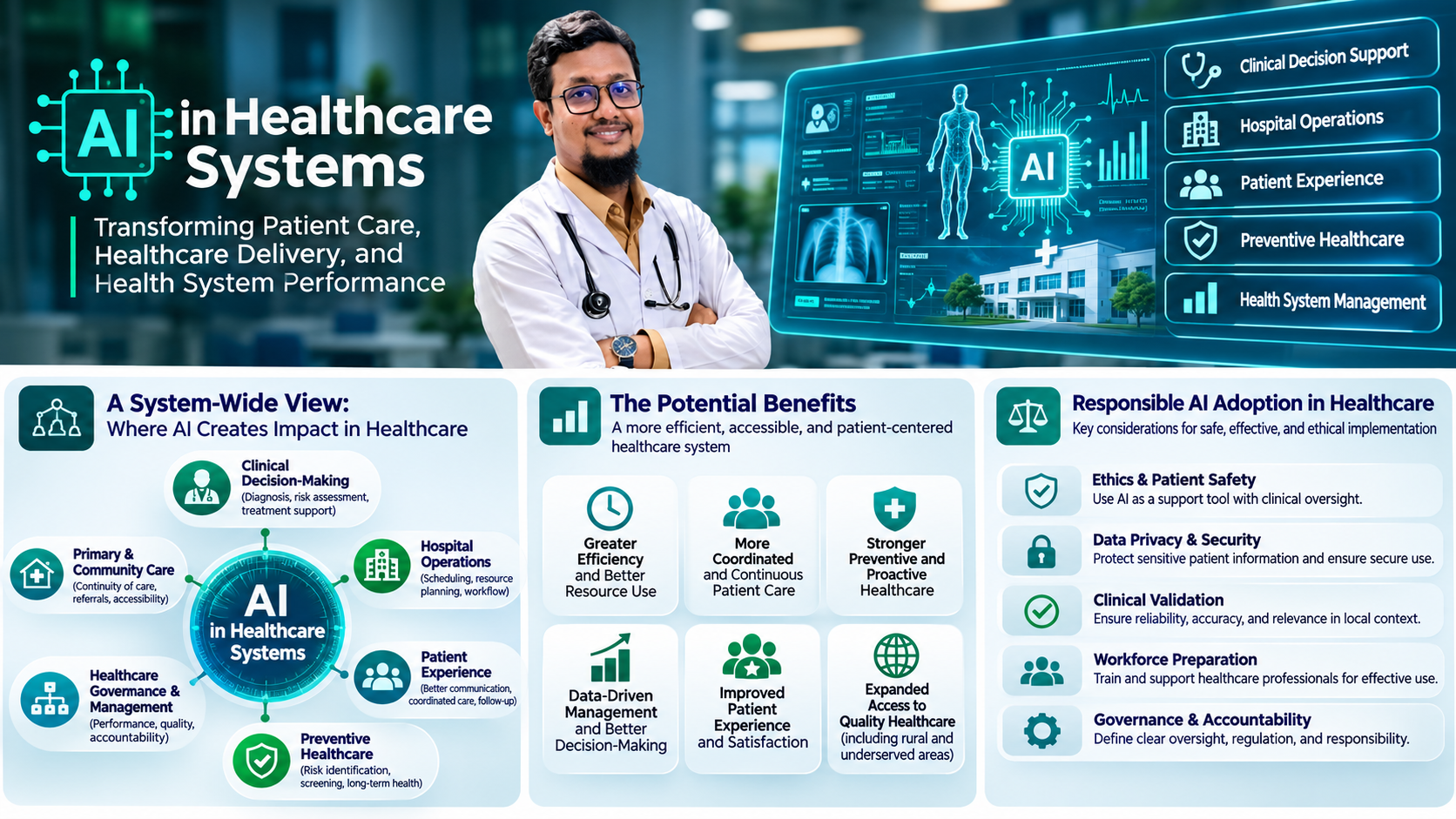
Artificial Intelligence in Healthcare Systems: Transforming the Future of Patient Care and Healthcare Delivery
Beyond Diagnosis: How AI Can Reshape Clinical Practice, Hospital Operations, Patient Experience, and Healthcare Accessibility
By Dr. Hamid
Physician | Healthcare Entrepreneur | Founding Director, Medimine Healthcare Ltd.
Introduction: Healthcare Is Entering a New Era
Healthcare has always evolved through scientific discoveries, medical innovation, and technological advancement. From the introduction of antibiotics and modern diagnostic imaging to electronic health records and telemedicine, each development has transformed how healthcare professionals deliver care.
Today, Artificial Intelligence (AI) represents another major turning point.
However, the influence of AI extends far beyond automated diagnosis, medical imaging, or robotic surgery. Its greater potential lies in transforming the entire healthcare system—from patient registration and clinical decision-making to hospital administration, workforce management, resource allocation, preventive healthcare, and long-term patient follow-up.
As a physician involved in healthcare entrepreneurship and healthcare system development, I believe the most important question is no longer simply:
“How can AI help doctors diagnose diseases?”
Instead, we should ask:
“How can AI help us build a healthcare system that is more efficient, accessible, ethical, affordable, and patient-centered?”
This distinction is essential because the future of healthcare will depend not only on clinical excellence but also on how intelligently we design and manage the systems surrounding patient care.
1. AI in Clinical Decision-Making: Supporting, Not Replacing Physicians
One of the most widely discussed applications of AI is clinical decision support.
AI-powered systems can analyze medical information, identify patterns, highlight potential abnormalities, and assist healthcare professionals in evaluating clinical possibilities.
Potential applications include:
- Identifying suspicious findings in medical images.
- Supporting ECG interpretation and cardiovascular risk assessment.
- Highlighting concerning trends in laboratory results.
- Assisting clinicians in reviewing medication interactions.
- Identifying patients who may require urgent attention.
- Organizing clinical evidence relevant to differential diagnosis.
These applications are not merely theoretical. The United States Food and Drug Administration reported that more than 1,600 AI-enabled medical devices had been authorized for marketing as of September 2026.
Nevertheless, authorization for a specific medical purpose does not mean AI can independently provide comprehensive medical care.
Clinical medicine involves much more than pattern recognition. It requires contextual understanding, ethical judgment, communication, empathy, and responsibility.
A physician must consider the patient’s individual circumstances, socioeconomic background, preferences, clinical presentation, and available healthcare resources.
AI can support clinical intelligence, but human judgment must remain central to clinical responsibility.
The goal should be to develop AI-assisted physicians—not physician-free healthcare.
2. Transforming Hospital and Healthcare Operations
Perhaps one of the most underestimated applications of AI is healthcare operations management.
Hospitals and diagnostic centers are complex organizations. Their performance depends on coordination between doctors, nurses, technicians, administrators, pharmacists, support staff, and management teams.
Even a clinically excellent healthcare institution may struggle because of inefficient scheduling, poor communication, fragmented documentation, or inadequate resource planning.
AI offers opportunities to improve these operational processes.
For example, AI-assisted systems may help healthcare institutions:
- Forecast patient demand and optimize appointment scheduling.
- Identify bottlenecks in registration, consultation, investigation, and discharge.
- Monitor inventory and anticipate shortages of medicines or supplies.
- Support staffing and duty-roster planning.
- Automate routine administrative documentation.
- Analyze service quality and patient feedback.
- Generate operational dashboards for management decisions.
Consider a diagnostic and consultation center where patients experience long waiting times despite adequate medical staffing.
The underlying problem may not be a shortage of doctors. It may involve inefficient scheduling, delayed registration, poor patient flow, or uncoordinated investigation services.
An AI-supported operational system could identify these patterns and recommend adjustments.
This illustrates an important principle:
Healthcare efficiency is not achieved only by increasing the number of healthcare professionals. It also requires improving how healthcare professionals, resources, and services work together.
When implemented responsibly, AI can help institutions make better operational decisions while allowing healthcare workers to devote more attention to direct patient care.
3. Improving the Patient Experience Through Intelligent Healthcare Systems
A healthcare system should not be evaluated solely by its diagnostic capabilities or financial performance.
Patient experience is equally important.
In many healthcare settings, patients commonly express concerns about inadequate consultation time, unclear medical explanations, fragmented healthcare records, unnecessary investigations, and difficulties navigating healthcare services.
AI cannot independently solve these problems. Many arise from institutional culture, financial incentives, staffing limitations, and accountability gaps.
However, properly designed technology can support meaningful improvements.
For example, AI-assisted documentation may reduce the administrative burden on physicians, potentially creating more time for direct patient communication.
Digital patient profiles can help clinicians review previous medical histories, investigations, medications, and follow-up recommendations.
Automated reminder systems can support continuity of care for patients requiring regular monitoring.
Patient education tools may also help explain medical instructions in more accessible language, provided that the information is clinically reviewed and appropriate to the patient.
Imagine a patient with diabetes and hypertension visiting several different healthcare facilities over time.
Without coordinated records, important information may become fragmented.
A secure digital health profile, supported by carefully validated AI tools, could help organize the patient’s clinical history and identify gaps in follow-up.
The objective is not simply to introduce more technology into the consultation room.
It is to help patients feel heard, informed, respected, and supported throughout their healthcare journey.
4. AI and Preventive Healthcare: Moving Beyond Disease Treatment
Traditional healthcare systems often operate reactively.
Patients seek medical attention after symptoms develop, complications arise, or diseases become clinically apparent.
AI creates opportunities to strengthen preventive and proactive healthcare.
Through appropriate analysis of longitudinal health information, AI systems may help healthcare professionals identify patients who could benefit from earlier evaluation or targeted preventive interventions.
Potential applications include chronic disease risk stratification, preventive screening support, medication adherence monitoring, population health analysis, and follow-up prioritization.
For example, a primary healthcare organization could use an appropriately validated risk model to identify groups of patients who may benefit from cardiovascular risk assessment or closer diabetes follow-up.
Such systems should not determine treatment without clinical evaluation, nor should they be used to exclude patients from necessary care.
The broader opportunity is to shift healthcare from an exclusively illness-centered model toward a system that also emphasizes risk reduction, prevention, and long-term health management.
This shift is particularly important for countries facing a growing burden of chronic noncommunicable diseases.
5. AI in Primary Healthcare and Community-Based Healthcare Delivery
Primary healthcare is the foundation of a sustainable healthcare system.
Yet community healthcare facilities often face limited specialist access, inconsistent documentation, workforce shortages, and difficulties coordinating referrals.
AI-enabled tools could help address selected aspects of these challenges.
For example, primary care teams could use digital systems to organize patient histories, generate structured clinical documentation, coordinate referrals, and identify patients requiring follow-up.
Telemedicine services could also benefit from AI-supported administrative triage, appointment routing, and clinical information organization.
However, clinical triage and diagnostic recommendations require stronger safeguards than routine administrative automation.
In community-based healthcare, simplicity is critical.
Technology must be affordable, usable by frontline healthcare workers, suitable for local languages, and capable of operating within real infrastructure constraints.
A sophisticated AI system that cannot function reliably in a resource-limited clinic has little practical value.
The most meaningful innovation may therefore come from integrating relatively simple, reliable technologies into well-organized primary healthcare workflows.
The future of community healthcare may depend less on building technologically impressive institutions and more on creating intelligently connected healthcare networks.
6. AI in Healthcare Governance, Management, and Accountability
Healthcare organizations require transparent leadership, effective operational monitoring, and clear accountability.
AI can support healthcare management by consolidating information from different departments and identifying trends that may otherwise remain unnoticed.
For example, a healthcare management dashboard might combine information about:
- Patient volume and waiting times.
- Staff availability and workload.
- Investigation turnaround times.
- Patient complaints and service satisfaction.
- Medication and equipment inventory.
- Financial performance and operating costs.
- Quality and patient safety indicators.
This information can support evidence-informed decisions by hospital administrators and healthcare leaders.
At the same time, AI introduces new governance responsibilities.
Who is accountable when an AI-supported recommendation contributes to a harmful decision?
How should patient information be protected?
How can institutions ensure that algorithms do not produce discriminatory outcomes?
What happens when an AI system performs poorly after implementation?
The World Health Organization has emphasized that successful AI adoption requires governance frameworks, transparency, appropriate regulation, workforce preparation, and protection of patient rights.
In a September 2026 report, WHO highlighted the importance of governance readiness rather than simply the speed of AI deployment.
This is particularly relevant for healthcare entrepreneurs and institutional leaders.
Introducing AI into healthcare is not merely an IT project. It is an organizational transformation requiring clinical leadership, operational redesign, and ethical oversight.
7. Challenges and Risks: Why Responsible AI Adoption Matters
Although AI offers substantial opportunities, healthcare organizations must remain realistic about its limitations.
AI-generated information may be inaccurate, incomplete, misleading, or biased. An apparently confident answer is not necessarily clinically correct.
Poor-quality training data may produce unreliable recommendations, especially when systems are used in populations or environments different from those in which they were developed.
Patient privacy and cybersecurity are also major concerns.
Healthcare information is highly sensitive, and inappropriate collection, storage, sharing, or processing can undermine patient trust.
Another significant risk is automation bias: healthcare professionals may become overly dependent on algorithmic recommendations and fail to recognize mistakes.
There are also economic and operational concerns. AI implementation may introduce new costs, vendor dependence, maintenance requirements, and staff training needs.
Therefore, responsible implementation should include clinical validation, secure data handling, clear accountability, human oversight, staff training, ongoing performance monitoring, and mechanisms for correcting errors.
Healthcare institutions should also evaluate whether AI produces measurable improvements in patient outcomes, service quality, efficiency, or accessibility.
Technology adoption should never become an objective in itself.
8. The Opportunity for Bangladesh: Building Smarter Healthcare Systems
For Bangladesh, the potential influence of AI deserves particular attention.
Our healthcare sector includes highly skilled professionals and expanding private healthcare services. However, challenges remain in service coordination, continuity of care, medical record management, access to quality services, and institutional efficiency.
AI may offer opportunities to address selected operational and organizational weaknesses.
In my view, Bangladesh should consider a practical, phased approach.
The first priority should be strengthening basic digital infrastructure: structured patient records, appointment management, electronic documentation, inventory systems, and reliable communication processes.
The next step could involve introducing AI into lower-risk administrative functions, such as appointment reminders, workflow summaries, inventory forecasting, and service performance reporting.
More advanced clinical applications should follow only when there is adequate evidence, local validation, workforce preparation, appropriate oversight, and regulatory compliance.
Special attention should be given to Bangla-language usability, rural healthcare access, affordability, data protection, and the needs of smaller healthcare institutions.
For healthcare entrepreneurs, there is an opportunity to develop systems that connect community health points, general practitioners, diagnostic services, pharmacies, specialists, and telemedicine.
Such integration could help reduce fragmentation and improve continuity of care.
Yet the success of these systems will depend on implementation quality, sustainable financing, institutional integrity, and the confidence of healthcare professionals and patients.
AI alone cannot correct unethical financial incentives, weak accountability, or poor organizational leadership.
Those challenges require deliberate structural reform.
9. My Perspective: The Future Is AI-Enabled, Human-Centered Healthcare
As a physician and healthcare entrepreneur, I see AI not simply as a technological advancement but as an opportunity to rethink how healthcare institutions are designed and operated.
I believe the most valuable AI applications will be those that solve real problems for patients, clinicians, and healthcare organizations.
An AI tool that reduces unnecessary administrative work and allows a doctor to spend more meaningful time with a patient may create substantial value.
A system that identifies operational inefficiencies and reduces patient waiting times may be more immediately useful than an expensive technology introduced without a clear purpose.
A secure, organized patient record that improves follow-up and continuity of care can also make a meaningful difference.
For organizations developing integrated primary healthcare networks, AI-enabled operational systems may eventually support coordination between healthcare professionals, service centers, management teams, and patients.
But technology must remain aligned with ethical healthcare practice.
We should never allow efficiency, automation, or financial optimization to compromise patient dignity, professional responsibility, or clinical safety.
The central objective should be to use intelligent technology to strengthen human capabilities—not diminish the human relationships on which good medicine depends.
Conclusion: AI Should Transform Healthcare Systems, Not Just Healthcare Technology
Artificial Intelligence is influencing healthcare at multiple levels, from clinical decision support and medical research to patient communication, hospital operations, preventive healthcare, and institutional governance.
Its long-term value will not be measured simply by the number of algorithms deployed or the volume of tasks automated.
It will be measured by whether healthcare becomes safer, more coordinated, more accessible, more efficient, and more responsive to patients’ needs.
For developing healthcare systems, including Bangladesh, the greatest opportunity may lie in combining clinical knowledge, ethical leadership, operational discipline, digital infrastructure, and carefully governed AI.
The future of healthcare should not be about replacing the human touch with artificial intelligence. It should be about using artificial intelligence to make healthcare more human, more intelligent, and more accessible to everyone.
Dr. Hamid
Physician | Healthcare Entrepreneur
Founding Director — Medimine Healthcare Ltd.
Professional website: dr-hamid.com
References and Further Reading
- World Health Organization. Ethics and Governance of Artificial Intelligence for Health: Guidance on Large Multi-Modal Models. 2024.
- World Health Organization. Artificial Intelligence Is Reshaping Health Systems: State of Readiness Across the WHO European Region. 2025.
- World Health Organization. Artificial Intelligence and Evidence-Informed Policy: Emerging Challenges and Opportunities. 2026.
- World Health Organization. Report of the Knowledge Community on Responsible Artificial Intelligence in Health. September 2026.
- U.S. Food and Drug Administration. Artificial Intelligence-Enabled Medical Devices. Updated 2026.